Wednesday, June 22, 2016

My Last Hot Season in Ramsa


They say that a picture is worth 1,000 words, so now i'll present you all with fourteen thousand words. Enjoy!


Did a great training with two counterparts, educating the female students at our middle school on the menstrual cycle and how to make menstrual pads out of locally available materials. 


Touching topics like these is very important in these small African villages. The series of trainings that I held was the first time many of our 13-17 year old students were hearing about topics such as "reproductive health" or "contraception". To put it in perspective, our middle school had two 17 year old students give birth (out of wedlock) and there are two more who are pregnant. 

On a positive note, the pharmacist in my village told me that many students went to the Health Clinic after our trainings to seek out some type of birth control. Success!


With the staff at our middle school after our end of the year meeting. They've all been with me since my first months in Ramsa and have given me deep insights into the education system in Burkina Faso. 


With my favorite neighbors. The father owns the two bar establishments in village, and together we've done some cool business related activities. The mother is my unofficial mother away from home - always cooking me food and taking care of anything I need. They only have 4 kids, but when the other neighborhood kids saw the camera they immediately jumped in. 

We took around 10 pictures, and sadly this is the best one haha.


Hot season also comes with dust storms. 


Everything turned orange for this 2 hour storm. I was stuck inside laughing my head off at how powerful and long-lasting it was. 


Finally was able to get UBER to open-up in Burkina Faso. All rides are on bikes - people pay with their smiles. We've yet to make any money.


Hermane and I went to my fellow PCV's neighboring village to give a Soy Transformation training.


Making those bomb brochettes. 

All the women enjoyed the experience and the tastes of the different soy products. Now, all we can do is hope that they'll continue on with this small business in the future. 


They're cute in pictures like these, but not when they're flying out of your latrine in the middle of the night.


Had a training at the beginning of the month in Leo, so of course my buds and I went back to our first bar in BF and had a few. 


Same bar, same people. First, ninth and fifteenth month in country. 


The wind has been extremely strong this hot season as you can see here. It blew off the roof of our newly constructed school, along with many other houses in the village.


And to end on a positive note, electricity has officially come to Ramsa! People will start installing in into their homes on a weekly basis. This is when development will really take off as businesses can evolve and offer a wider range of products. 

Hope you enjoyed this picture-filled post. I'm off in two days to see my family in Europe. It's been a long time coming. Can't wait!

Until next time,

MB

Friday, May 6, 2016

La Santé Avant Tout

It’s been a year and change in village thus far. My first year was filled with many cool projects, big and small. However, they were mainly concerning my primary sector, community economic development. Sure I’ve done some health trainings here and there, but they were small in nature.

Recently, simply due to the luck of good timing, my village and I were able to undertake two solid health projects in Ramsa. The first was a two week enriched porridge training with 9 women with malnourished children. The second is a community-based largescale malaria project which will carry through until the month of November. I brought these two project ideas to my community, but it was been them (especially my Health Clinic’s Head Nurse and one of our Community Health Agents) to have taken the ideas and turned them into reality.

The porridge project, which in French we call “Le FARN”, or “Foyer de l’apprentissage et réhabilitation nutritionnelle”, is an intensive two week project with the goal of getting malnourished children to gain weight. Each day we would first do a mini training on an important health topic (such as nutrition, hygiene, family planning, or malaria). We did this because to properly raise a child, one needs to do much more than provide good food. Afterwards would train them on a new porridge recipe, using only local ingredients to ensure that they could actually practice these recipes at home. All of the materials were paid for by the participants, and this aspect was crucially important to me. In Burkina, there are a lot of free handouts coming from outside donors. One example is free grain powder/nutrition bars for malnourished children. In theory, these gifts should rehabilitate the children in a certain amount of time. But, most times it is consumed by other members of the family. Having the participants in this project pay for the ingredients and other materials was a way to start training them on being accountable. The lesson that they could effectively nourish their children using their own resources and not relying on outside gifts was probably the most important take-away of this project. Again, I was there in a facilitating/organizing/supporting role while my counterpart led most of the trainings and saw the project to its end.


We take the baby's weight on the first and twelfth days to monitor their weight gain (or loss). 


Mixing in other health trainings as well. Here my counterpart and I are informing them on the three food groups. Images are key.


Voici the porridge. The women had no issue cooking. Equally as awesome, everybody shared the work and didn't complain.


Training on family planning. 


End result: baby happy with full stomach, mother happy because baby is happy.

In the end, nearly half of the babies gained a good amount of weight. The rest were neutral, but if they continue with the porridge at their homes they will surely see positive results in the coming months.

During the second week of our porridge project, we started another endeavor in the health arena. The PECADOM+ Malaria project was started years ago in Senegal and has proved to be an effective way to combat malaria in the village setting. The present situation in village is that malaria is very normalized to all villagers (kind of like the common cold back in the US), resulting in many people simply living as a malaria host without seeking treatment. This enables malaria to be easily transmitted within family compounds with its proliferation never-ending. In this project, community health agents will do weekly sweeps in each neighborhood and give a free malaria test to anyone showing symptoms. They will then be able to buy medicine right then and there if tested positive.


My Health Clinic's Head Nurse (bottom right) training our health workers on how to administer the malaria "Rapid Diagnostic Tests". 


Our first day in the field. For the tests we have to draw a bit of blood. The little kids either react one of two ways: they do absolutely nothing or they throw a massive tantrum. 


She was tested positive :(

Last month we did our first test-run, to give it a try and see what difficulties would come. The first couple of days were a bit rough but by the end each team had their process down and could do up to 50-60 tests in one 2-3 hour sitting. The results from this test-run were staggering. Almost in each neighborhood around half of the people that were tested were positive with malaria. One night 39/67 were positive, mostly children. This is shocking for me because it is currently the hottest period of the year when malaria is supposed to be at its calmest. I’m apprehensive now to see the data when we start this project when the rains come (which is the worst time of the year for malaria). The silver lining of our test run was that each worker saw the importance of their contribution to the community and is ready to carry this project though during the rainy season, despite having to farm all day before setting-out into the village for their sweeps.

In other news, my counterpart Hermane and I were able to execute a successful Animal Husbandry training exchange at my friend’s village in another region of Burkina. It took us all day long to travel 100km. We were tired and anxious, wanting everything to go perfectly. And it did. Hermane did a professional-style training and the participants were engaged each day from 8-5, despite the blistering heat. This training was very heartwarming for me, since I know that at least with my counterpart in my village our work will continue on because of his hard work ethic and tremendous capabilities.


Starting off our first day talking about chicken coups.


A true Burkinabe Change Agent. Helping his country by using his gift of effectively sharing knowledge. 


All the participants except my fellow volunteer, who is taking the picture.  

Rainy season starts in a month, but not before the single hottest month of the year. Hopefully I can make it through.

Until next time,


MB

Tuesday, March 22, 2016

The One Year Mark (in Ramsa)

The “one year left” countdown has officially begun. March 20, 2016 marks my 365th day spent in the village of Ramsa. In another year, I should be back on a plane headed back to America with 26 months of Peace Corps Service under my belt.

Currently, I’m in a duo-state where I feel like time is speeding-up, but also slowing down. The days seem to blend together now. A week will begin, activities will go by, and suddenly I’m waking-up Sunday morning for my relaxation day. Fortunately for me, the oncoming heat is acting as a de-catalyzing agent to slow my life down. In my region, April à June is known as the “tuulgo wakate”, or hot season. These three months present us with unrelenting heat before the rains come at the end of June. Even the Burkinabe complain about this heat. There are a few positives to note of this season: I get to sleep outside, literally under the stars; bucket showers at the end of the day make the previous 12 hours almost bearable; my solar-powered battery is always charged. Then come the negatives: non-stop sweat, even at 3 AM; the return of camel spiders; dust storms; more sweat. Surprisingly I feel significantly less apprehensive than before the previous hot season. Last year I struggled a bit acclimating to the heat, but this year my body is more in tuned with the heat and the side-effects it brings.

Since my last blog post, I’ve been extremely busy attending trainings outside my village as well as getting to work in Ramsa. In chronological order, voici mes activités de les deux mois passes:

1.       Dance Marathon / Camp "Laafi”: The Youth Development Committee in Peace Corps Burkina Faso holds a series of Dance Marathons in Burkina Faso to fundraise for youth-related activities in the country. My fellow volunteer Brian and I decided to combine the Dance Marathon with his Camp Laafi (which means “health” in the local language) at his site. The combination worked out flawlessly. 6 Peace Corps Volunteers taught health related trainings (more specifically HIV/AIDS and family planning) to around 80 Burkinabe students, while mixing in many American style dances between the trainings. The students learning so much valuable, basic information that pertained to them in their young-adult lives. However, the American dances were what honestly shaped the entire experience. Over the two days we taught our enthusiastic students staple dances like the “Macarena” and “the Chicken Dance”, as well as newer ones such as “the Nae Nae” or “the wobble”. The students loved watching us 6 volunteers do these strange dances. After the camp was finished, I actually saw students back in the village doing the chicken dance by themselves! 


Dancing the "Cotton Eyed Joe". My fellow PCV Brian leading the dancers.


Dancing the "Cupid Shuffle" with my friend Meghan.


We would keep the dance going after the day's activities were finished. They kids loved dancing with each other.

2.       Peace Corps Site Visit in Ramsa: On February 24 one of my bosses came to Ramsa to give me my mid-service site visit. Aicha, who is a Program Assistant for the “Community Economic Development” (CED) Sector, came to my village to talk with my villagers and observe upon some of our ongoing projects. I am in constant communication with our CED team back in Ouagadougou updating them on any current projects or questions I might have. However, it is necessary for them to talk in-person with my work and community members. Overall, the visit went very well. My community had much to say. They’ve appreciated my contributions thus far. Then, they went on to voice some of their desires for possible projects to take place in the coming year. Following the conversation we surveyed our potato gardening project as well as the condition of our moringa garden. So far, so good. The visit was over before I knew it and then we were back to work that afternoon.


My Boss and I conducting a "town-hall" meeting to assess the quality of my work over the past year.


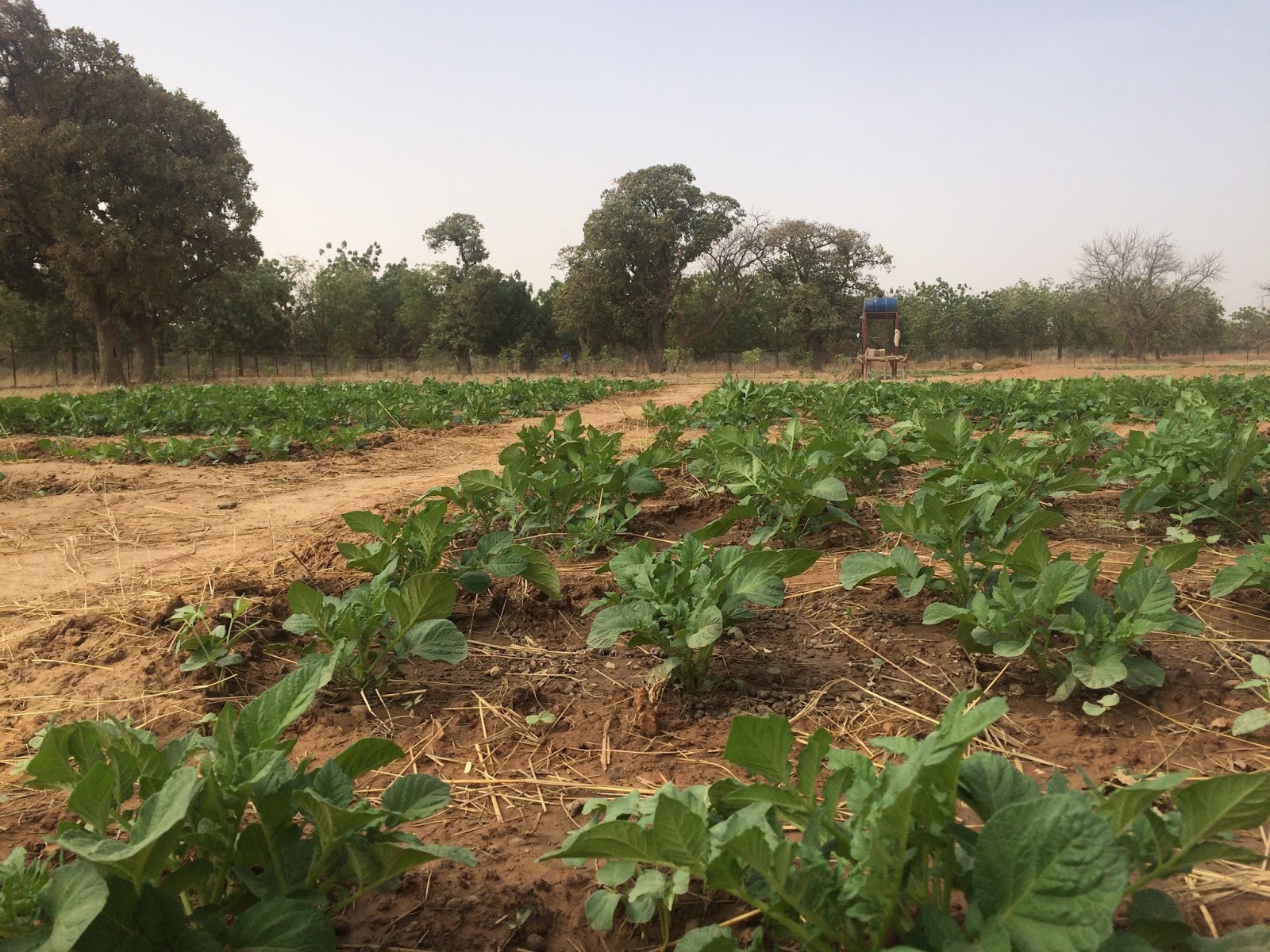
Surveying one of our small potato gardens. Here the potatoes are about 3 weeks before harvest.


One of my village elders presenting my boss with a chicken as a parting gift. 

3.       Agriculture / Animal Husbandry Training: The Peace Corps holds a few “Food Security” trainings for volunteers throughout the year, focusing on things such as beekeeping, soy or gardening. This training, which mainly focused on animal husbandry and fattening, was a clear choice for my village since almost everyone practices some form of animal husbandry. Big or small, chickens or goats, everyone relies on animal production to give them a small income boost, provide them with animal waste which later turns into compost, or to help them labor their fields before seeding. Throughout the 4 day training we learned on professional animal husbandry techniques which were also applicable at the village level. My two counterparts, including my main counterpart Hermane, took a plethora of valuable information from this trainings which we will later share with our community members. This training felt different from the soy training that I attended in January, since the need for improvement in this area was apparent the moment I arrived in village. Almost every one of my savings groups expressed an interest in learning techniques to improve their animal raising. After the training was finished, I couldn’t wait to share our finding with the villagers of Ramsa.


During our training we visited a model chicken coup. The goal is to one day be able to construct habitats like this for our village chickens.


Hands-on training on how to properly make compost. I've gotten quite good with a machete.


At the end of the training with my two counterparts. Proud of these guys.

4.       “FESTIMA”, or International Mask Festival: The two days following our animal training in Koudougou, I took a two-day vacation to the city of Dedougou to witness the International Mask Festival which takes place every two years. Tribes send representatives to this festival to showcase their local mask and costume, as well as their traditional dance and rituals which accompany them. I heard from a few older volunteers that this was one of the few Burkina activites that was a must. I wasn’t let down. Countries from West Africa, as well as regions from Burkina Faso, put on dance after dance to entertain a crowd of around 2-3 thousand viewers. These rituals, which were mainly practiced in the past, were primarily in animist regions to call upon the higher powers to bring good rains, good health, and ward off bad spirits. I enjoyed this festival especially since masks aren’t popular in my region so it was my first true taste of this local practice.


A traditional mask from Burkina Faso


Representatives from either Togo or Benin.


Representatives from the Western Region of Burkina Faso.

5.       Potato Harvest: For the past three months, some of my community members have been growing potatoes with the intention of selling in bulk once harvested. Potatoes do well in my northern region so we knew if the gardeners followed the proper procedures, all would turn out well. We ran into a few unanticipated setbacks along the way. The land in our new garden space has been fallowing for some time, so it isn’t as nutrient-rich as some other plots. This, coupled with some gardeners who didn’t properly prepare or apply their compost, resulted in a weak harvest for a few. Not to worry. The majority of our gardeners produced solid amounts and will be able to take home some profits. Needless to say, next year for our second attempt everyone will know all of the necessary procedures for awesome potato production.


Mid-way through the harvest. It was a-lot of work, but since it was the "riib-daare" or the "day when we get food/money", our gardeners powered through.


We harvested little over 2 tons of potatoes. Pictured the morning before shipping them off a buyer we found in our regional capital.

6.       Animal Husbandry Trainings in Ramsa: My two counterparts and I were excited to bring back the knowledge we gained and share it with our community. We understood that animal husbandry trainings would be beneficial to the entire community, not just our work organization. I designed an information flyer and posted it around village. So far we’ve done 2 trainings. Chicken raising is by far the most popular in village, so that had the largest turnout. Behind is sheep/goat fattening. Lastly is pig farming (since my village is 98% Muslim, only the small Catholic community can raise them). Without a doubt, the biggest highlight of the two day-long trainings that we held was the performance of my counterpart. I had no idea how effective he would be as a trainer. He translated the manual we received into Mooré and simplified everything so that our villagers could better understand. I was also pleased to see him take some of the training techniques that he observed during the professional training that we attended. Asking their expectations at the beginning, keeping them engaged, quizzing them throughout to see what they’ve been retaining and having fun throughout. I aided him by occasionally adding my two cents and drawing many pictures on the chalkboard of model chicken coups or the animal feed recipes, but it was clearly him running the show. Our goal in the coming year is to help these villagers now put what they learned into practice.


My Counterpart talking about where our village chicken raising is currently, and where we would like to end-up eventually. The use of pictures was very important because we any written instructions wouldn't be understood.


Diving into chicken feed.


Chicken feed formula based on the age of the chicken. Primarily corn/sorghum powder mixed in with fish/soy powder for protein. Also, a small mineral mix to add other necessary elements.


Peace Corps'ing

It was during these trainings when I realized that even after I leave Ramsa, work will continue. My counterpart has been learning so much new information either from me or through trainings. It was clear then that he can effectively transmit this information to the village when Peace Corps no longer exists there.

Hot season is here… If you want to imagine what I’m doing, I’m probably half-naked sitting in the shade trying to escape the sun. And so is the rest of my village.

Until next time,

MB

Wednesday, February 10, 2016

The One Year Mark

The one year mark for PC volunteers is a milestone with heavy significance. It shows how far we’ve come in our service, from the first day stepping off the clueless about Burkina to becoming a tenured volunteer who can handle any diverse situation. We’ve all been through a lot in the past year. The move to village, finally all alone in a foreign land, was a big one. The first “real” conversation in the local language was rewarding. When the project that has been taking months to implement finally came to fruition, it was a good feeling. And then the one year mark comes along and we realize that we are (nearly) half way done with our service. Initially, it’s a sense of relief because we have 15 long months left to use our acquired knowledge and get stuff done. But then it dawns that the remaining time is in fact too short, especially after we’ve digested the magnitude of problems in our village that need attention.

(All pictures will be after the text, since I don't have enough time to inter-crops the photos throughout the post).

All this being said, I’m content with myself and the work that is happening in Ramsa. Yes, the remaining time is short with too many things to do. This means one thing: prioritization. I initially wanted to do tons of projects (because I saw their potential worth and success) but now it’s about narrowing down to the sustainable few that will last after I leave. One thing’s for sure, if by this time the community is not motivated in a certain area, best let it go. The community’s motivation, participation and ownership is the vital ingredient to any Peace Corps for it to carry on. That being said, I’m excited for my community and I to narrow our focus and really build-upon the select few projects that interest us.

Before the turn of the New Year, we finally finished the construction of our new garden space. Fast-forward to today and you’ll see that the garden space is filled with sprouting leaves and growing trees. It’s a warm feeling knowing that our first endeavor is done and is working. I’ve been coming to the garden space as much as possible, even as my work there is slowing down. The evenings are the best. Entire families come-out to tag-team the watering of their plants or to do some weeding. The scene is quite fulfilling.

I told my counterpart and community that this project will never be finished, since we must always be looking for ways to improve what we have. This mainly speaks to the moringa trees (because of their vast economic benefits and ever-growing market), but gardening techniques and maintenance must always be improved as well. Once we finish digging and cementing the new well, the garden will officially be done and completely in the hands of the community.

My buds and I, as much as we love Burkina, decided to take a trip over new years to the Ivory Coast. We had a solid crew of 5 and we took the 34 hour train ride from the landlocked country of Burkina all the way down to the beach. I never knew how much joy the ocean would give me. After not seeing it for a year I knew the reunion would excite me, but not as much as it did. I spent an average of 5 hours each day in the water, just to let my body recharge. It was a treat traveling with my fellow PCVs because they appreciated everything just as much as I did. Unbeknownst to us, we carried our already engrained Peace Corps mentality with us to the Ivory Coast. At all times we were searching for locals to integrate with or hole-in-the-wall restaurants to find a cheaper meal. Eventually, the 10 day getaway came to end and we were back in Burkina.

A few weeks after our return, the horrible terrorist attacks in the national capital took place to much dismay. Burkina’s had a shaky couple of years, with the coup d’états and other danger in the region, but we ended 2015 on a positive note after democratically electing the first President in 27 years. The attacks in January reintroduced the doubt about Burkina and the West African region that everyone thought was on its way out. My fellow volunteers and I were saddened and shocked, and thought that there would be some action taken as to our situation in Burkina. Ultimately after much discussion, the Peace Corps HQ decided to let the Burkina mission remain intact, albeit with heightened security parameters and condition. Now, it is very difficult for volunteers to come to Ouaga unless for an emergency. It’s going to be like this for some time. Our safety situation is definitely more dangerous than before, but I am confident that the Bureau is taking all necessary measures to ensure our safety. The minute that they believe that they cannot guarantee our safety in country, we’ll be on the next flight home. Until then, all of us are safe in village going about our business and continuing with our Peace Corps work.

I’m at ease that we’re here for the (near) future because this part of my service is when my productivity is at its all-time high. Personally, I’ve reached a level with my local language, community integration and applicable knowledge to serve my community at my full potential. My counterpart and other core colleagues in village all have a solid understanding of our on-going projects and what we can achieve in the next year. With the moringa/community garden as our primary, on-going project, there are a few other areas that we are going to focus in 2016. Soy, animal feed, malaria and other small trainings by community demand. I’ll elaborate more on these other projects as they come about (we’ve started recently with our soy trainings and their popularity is sky-rocketing!). Of course, I’ll still have my own personal work that I’m doing at our middle school with my students.

February will be an activity-filled month for me and will also mark the unofficial end of “cold” season. March the temperature will be turned-up a bit before it hits full blast in April and May. Can’t wait.

Besides that, life is easy now. During my first year I found that after around 2-3 weeks in village I’d be itching to get-out and unwind with some friends far away. Now, it’s the opposite. Not that I don’t enjoy seeing my friends and eating good food, but I’m trying to plan my schedule so that I can spend as much time in village as possible.

Hope you enjoyed this post. I know it’s been a while between entries. I seem to have adopted the Burkinabe perception of time now, i.e. always late. But, you know what they always say…"Ca va aller". Everything will work out just fine.

Until next time,


MB


Getting ready to board the 34 hour train from Ouagadougou to Abidjan. Worth it.


The first of many beers on New Years eve in Abidjan. They served beers in 1 liter bottles. Needless to say, it didn't take many to get where we were going.


We were all super bummed to be away from Burkina.


New Years Eve dancing. We tried to get the Ivorians to dance with us. Instead, they opted to film the crazy white people while they danced by themselves. We've learned to play the fool after living in Africa for a year already.


Partying with locals is the best. The guy on the left was a bit of a creeper however.


Henry and me. Water, sand, palm trees for miles.


MVP of the trip: GoPro


Our hotel guide took us on a canoe ride of the lagoon. 


Surfing with our bodies.


Fresh fish in Ivory Coast. I bet even people in the US are jealous of this picture.


Last night we roasted hot dogs and marshmellows on the beach. 


Couple days after getting back to site and already back to work. The start of our compost training, taking place in our new garden. My neighbor is the government farming agent and we partnered with him to run this training. 


It took soo many weeds/hay to fill up this pit. It's a lot of hard work to fill and maintain, but the finished product's value is so valuable. Everybody is in need of a compost pit but not many people are able to, for many reason.


My farming agent finishing up the training. Pictured is the second compost pit, which we use to turn-over the pit so that the weeds on top can then decompose once on bottom.


Had the awesome opportunity to take two counterparts with me to a soy training, led by the Peace Corps. 


We learned a good deal about soy. Afterwards, we knew that we had to share this plethora of knowledge back with our community so that everybody could benefit from this nutritious product!


How I travel to my regional captial from my village and back. In the back piled on top of a bunch of cargo. My entire body is covered in dust by the time the journey finishes.


Potatoes sprouting up in our garden space.


Gardening season means vegetables. Tuna sandwich with carrots is my favorite meal in village.


Lettuce coming in little by little.


Just a week after returning from our training, we held our own village training on the importance and transformation of soy into tofu, yogurt and gateau. We only started 2 hours late with the majority of participants showing up midway through.


Mixing the soy flour. Once the women understand the procedures, the cooking part is easy for them. They could stir and mix until it is nice and pure.


After adding the congealing agent, the tofu appeared ontop. Then, we scooped it out and pressed until all the water left. In the local language, we have to call tofu "meat". So, when I was telling everyone that this concoction that we were taking-out was meat, they were very confused.


Tomato season also means that it is perfect time for tomato paste jarring. This was a great training because I was on my own (counterpart was busy) so I led the entire day in Moore. Boiling the jars before and after is important for a lasting conservation, because it kills all of the germs. 


Finished product! The ladies already sold a few jars to the government workers in our village.


Community Garden of Ramsa (with) vegetables and moringa. Year of completion 2015


Started digging of our new well which will allow us to garden year round. Moringa trees growing in the background.


I've been working with the local restaurateur in village to improve his bread. I introduced a new recipe and it's been selling like crazy. Here, his apprentices showing the uncooked bread before it goes into the oven. 


Souleymane making the loaves. He believes that I'm a bread expert, even though I got the recipe from a fellow volunteer and looked up the rest online. The power of information!