Saturday, July 25, 2015

Two Indisputable Truths in the Village of Ramsa

Six months down, 21 more to go. Life here has been great so far. I’ve been lucky enough to do some meaningful work already while integrating myself into my new community. I hope that the next two years are filled with an abundance of work projects for my community and me, because that is what I came here to do. Work. However, if I were only to share my work updates then I’d be excluding the other major platform of the Peace Corps mission, which is to share the local culture and lifestyle with my fellow Americans back home.


A picture of my garden. Here we are looking at our tomato beds where we just transplanted our saplings from the nursery.

As I get to know more people in my community I am able to find people to hang-out with. Sitting and chatting among friends is a daily activity here since there is no TV or internet to hold people hostage in their homes. For the most part I chat with my counterpart Hermane, a group of women who live next door or students around 18-22 years old who speak good French. I’ve recently found myself hanging-out more with these students because they are extremely curious about the outside world and all have strong opinions. However, most of what they think they know is completely false. The lack of information reaching this tiny African village is apparent. These students may see a film in school or read an article in the internet café, and this single exposure will solidify their opinions as if they were fact. They don’t have the ability to do research and find supporting evidence to their claims. Some examples: The Illuminati control the world and chose the amount of people who died during WWII, all homosexuals are evil because one video showed a group of them trafficking adolescent boys, and France currently is doing everything they can to oppress Burkina Faso. These are just some examples of topics that have come-up during our conversations. Of course I try and present the opposing argument but their minds can hardly be swayed. 


Here is a picture of our cucumber section. We will plant some corn inbetween.

I also must be cautious when reaching heavier subjects here in Burkina Faso. During our training we were told not to talk about certain topics, like politics, religion and homosexuality. The reason for this is because the local mentality concerning these topics is essentially set in stone so persuasion is impossible. It’s sad that I have to hold back or lie about my personal beliefs, but in some cases it is necessary. The two big ones are religion and homosexuality. Religion is everything here and I can see it everywhere. Muslims pray at least two or three times a day. Christians don’t just go to church on Sunday but every single day at 6 AM. This is why people here cannot understand someone who is atheist or doesn’t identify with a religion. For this reason the Peace Corps told us that to avoid constant questioning and/or arguments it’s best to say we are religious whether or not it’s true. The same with topics surrounding homosexuality. When the subject comes up I do my best to tell them everything I know but I can never say if I support it or not, as much as I want to. My alibi is that the Peace Corps said we’re not allowed to share that information. What it comes down to is job security. If a Peace Corps volunteer openly admits that they support homosexuality then they could personally be at risk in their village. This single piece of knowledge would make people resent the volunteer and prevent any meaningful work from being done. In the past the Peace Corps had to “medically evacuate” a volunteer from their site because he/she shared their views with the community and shortly thereafter the community wanted him/her to leave. It’s sad, but over here that’s just the way it is…for now. Hopefully in the future things change. 


A picutre of some of the members who will be running the Moringa garden with me. We usually meet twice a week to talk over details of the grant, as well as to start mapping out rules and guidelines for this project.

So, now to the title of this blog post. 

Two indisputable truths in Ramsa. Recently I had a conversation with two friends in my village. We discussed many deep topics, and for each of them my two friends had a warped perception of reality. I did my best to try and persuade them using my sub-par French, but in the end we weren’t really getting anywhere. I decided to try something new and ask them to try and prove two indisputable, 100% true facts that are present in my village of Ramsa. These are educated men so I told them I wanted evidence and everything so that they could prove the legitimacy of these claims. After deliberating for 15 minutes, this is what they came up with: 

• In Ramsa, there exists a sacred location, where if any type of animal is sacrificed then perfect farming weather is guaranteed for the next year.
• Life was better in the olden days when women had no power in the family structure. Now that women have more power / rights (which results from Western culture influence since the start of colonization), life is worse because women spread family secrets and ruin the integrity of the family.

I was blown away at these two responses, because first of all they are not facts but secondly because I expected educated men who have a legitimate chance of going to university to have more sense. I dissected each of these claims with my friends to see what they were thinking. For the sacred sacrificial location, I asked why they wouldn’t sacrifice an animal every year to guarantee good weather but they couldn’t really give me a straight answer. I told them that I would be willing to buy 10 chickens (for $40) and sacrifice them myself to help out this village. I hope that take me up on this offer. 


The HIV/AIDS session at the youth conference I attended. It was awesome to see all of the students engaged in learning about what are typically "taboo" topics.

For the other claim, I was very upset because they claim that every single person in Ramsa feels the same way about women. How could they not see the importance of women and all that they do in their culture? They actually knew that women are extremely successful in the US and in Europe, but this claim was only about small-village African women. Now, personally, I understand that I need to focus much more on women’s empowerment in my village. Here is a fact: all humans are the same and can contribute equally to society if given to chance. So, if women were given an equal opportunity and elevated to the same level of men, wouldn’t Burkina Faso be able to utilize ~50% of its workforce that wasn’t previously available? I’m enthusiastic that over 75% of the members of my host organization are women. Others, with less bias, have said that women are the only ones who work in Ramsa. In the dry season they have their small business and in the rainy season they farm. All the while they have to cook, clean and run the household too. And the best part is that studies show that when women make money in developing countries they tend to spend it on things for others, like medicine for their family or their children’s school fees. I’ll stop here.


Here I'm with the two students that I brought to the youth conference, Zalissa and Philippe. They both killed it and I can't wait to see how they share the information back with our community members.

In other news, I’ve been pretty busy this past month. I’ve been out of site for 3 of the past 4 weeks so I’m glad to be heading back to village for at least a month without any more trips. My two week In-Service-Training was great. I got to see all of my friends in one place again. We learned a lot and will start implementing projects and trainings very soon. This past week I was also at a Youth Development Conference. I brought two students from my village to learn how to be an active citizen and a leader in the community. We will partner together to carry out some malaria awareness raising activities immediately, and in the future collaborate more on other projects. It seemed like these students really got a lot out of it, so I’ll be looking for other conferences to take my community members to. My garden is growing and I’m pretty much there all day long. Three hours in the morning and afternoon, picking weeds and watering the plants. I hope this goes well so that people next rainy season will pick up rainy-season gardening and make some more income. But, behavior change is extremely difficult here so we’ll just have to wait and see. 

Until next time,

MB

Saturday, June 13, 2015

(Unofficially) Underway with my Peace Corps Projects

As a Peace Corps Volunteer my service is first buffered by a three month “community analysis” period where we are supposed listen, learn and discover this new way of life. No work is supposed to start until after our 2 week training from June 29 to July 10, where we will learn a bevy of projects and trainings to take back to our sites. This is when the “real” work begins.


Those who have enough money to buy cement will transform their dirt courtyards into a cleaner, dust-free area. This activity is done only by women, who gather in bulk to transform one person's courtyard. I was the only man there and did a good amount of work, so they women bought me a fanta afterwards! (FYI this is a very nice courtyard for my village standards)

About a month ago I realized something that I knew I must act upon. My two week training will end during the beginning of the “rainy season” when literally 99% of my village inhabitants are in the fields all day farming. I already knew that I wouldn’t be able to initiate any projects until after the harvest in October. But more importantly I realized that I wouldn’t be able to use the ample rainfall (which is extremely precious in my otherwise dry village) to aid the growth of crops that I could use later for my projects. So, for the previous month I have been scrambling with my organization to attempt to start some projects before I leave for my training. 

It’s been tough coordinating meetings especially when everyone is preoccupied with their personal farms. Even more difficult was educating my leadership team on the potential benefits of these new projects. Thankfully after many meetings the message got through. This head-start will save my organization and I time, money and allow us to use two rainy seasons instead of just one during my service. 


Looking at the vast field which separates my neighborhood with the main road / market area.

Project #1: Moringa Plantation
Moringa Leaf Transformations is a very popular project among PCVs because the trees thrive in this West African climate and the leaf power has a crazy amount of health benefits. This project will aim to help my group members earn extra income by selling this leaf powder (maybe even eventually to outside markets and buyers), but more importantly it will help address the severe nutrition problem in my village. Everybody is on-board and excited to start this project. The Peace Corps even gives out free seeds to volunteers. My group and I were going to try and start planting saplings this month but we ran into one specific issue: cost of fencing. Fencing to enclose one hectare (or 400 meters) can cost around $300-400 which is too heavy of a cost to incur for my organization. Fencing is absolutely necessary because animals love eating Moringa trees due to the high amount of nutrients. Luckily, my PC boss came in clutch said there is a grant I can apply for, and if we act on it quickly, we can get the fence funding by early August. This means that we can have a bit more time to plan out the details for this project. But, come August the gears will be churning with this project and that precious leaf powder will be only a year away!


Our river is finally filling up. During the height of rainy season water will expand beyond the borders of the picture and rise a couple of meters. Many fish will come, but so will crocodiles so people don't really swim in the river.

Project #2: Soybean Farming (and later transformation into tofu)
Another popular project is soybean transformation into tofu brochettes and other soy products. This is another income generating activity (IGA) for my community members which will also provide a nutritious food option to the public. Explaining soy was tough because none of my villagers knew what soy was. It only exists in larger cities. There is no word for soy in the local language, so I made-up a few alternatives. “Nasara Benga” translates to “White Person Beans”, or “Benga Nemdo” which means “Bean Meat” to describe the tofu kabobs. I then had to stress that “Nasara benga kõta laafi la kõta panga wusgo”, which means that “soy give health and a lot of strength” so they understand this too will aid the nutrition problem in Ramsa. My leadership team liked the idea and set-out to collect some money from each group to pay for the seeds. The Peace Corps office helped us find a vender and he just shipped us our 30 kg order of seeds this past Friday. The grains will be distributed to 10 of my work groups and come September we will have nearly 200 kgs of soybeans ready to be transformed!

Project #3: Rainy-Season Garden
Gardening is primarily a dry-season activity for villagers in Ramsa because during the rainy season everybody focuses their energy on cultivating grains, which they will then eat over the next 12 months. This means that my local market will be depleted of vegetables during the rainy season. So, why not find a way to supply the market void? The idea of a rainy season garden seems highly feasible since there will be no competition and the rains will provide a free water source. The idea seemed ripe for my organization members and me, but ultimately I wasn’t able to draw enough interest since people didn’t want to risk losing their money and they’d rather spend their time on their own farms. I cannot blame these people because they don’t have very much extra money to invest. Their mindset and the way they approach a new idea isn’t the same as mine. Another reason why people wouldn’t commit to this project is because there isn’t an example of someone having success with a rainy season garden, so I thought to myself “why don’t I start my own?” This is exactly what I am going to do. I, along with a few high school students, are going to borrow some fencing, invest in some seeds and start a rainy season garden. Our main three vegetables will be tomatoes, onions and cucumbers. My ultimate goal is to draw people’s interest to this project idea and show them my (fingers crossed) success so that they can do the same next time around. 


My 19-year old friend Phillipe cutting down some tree branches that will serve as our fence posts. He is entering his second to last year in high-school which is quite a rarity in our village. He will use the money that we (hopefully) earn from this garden to help pay for his schooling. 

My role as a Peace Corps volunteer is finally becoming clearer to me. Initially I didn’t know what type of projects to conduct or how involved to get. A big unanswered question was also what skills and knowledge did my community members possess? Thankfully now, after dealing with the three projects above I have a clear vision of my next two years in Ramsa. I will be the one to introduce ideas, educate on the possibilities, organize project implementation, transfer my knowledge to the intended parties, solve any problems along the way, and also monitor and evaluate the progress of each project. Eventually I need to pass all responsibilities off to someone else so that they can manage projects old and new when I’m gone. My leadership team members will be in charge of helping me conduct feasibility studies, disseminating information to all group members and organizing logistical work and training information. The hundreds of group members will be the recipients of these new project ideas and trainings to then use for their own households or as a new income generating activity. Everybody is eager to work and their motivation makes me believe that anything is possible here. 

In-between the three projects above I’ve also found other ways to help out in the community. A couple of times a week I will go to the health clinic and give awareness-raising sessions on the importance of nutrition, hygiene and malaria. Depending on the day my audience can be just a couple of people or upwards of fifty. I want to take a good look into the current practices in these three domains and provide educational material that will hopefully lead to behavior change. I will also see if it is feasible to incorporate some trainings into these visits, such as how to construct household hand washing stations or how to create enriched porridge for malnourished children. In addition, I started to work with the local students association in Ramsa. I will mainly help them find ways to raise money because they want to furnish a library with books and create a central study location for students in village. I gave them the idea of a motorcycle wash to raise money, as well as how to craft well-written donation letters to members of the community. So far, both have turned out to be quite fruitful and each day we get closer to completing our fundraising goal. We will also be embarking on some educational awareness raising events this summer to help change the education culture in Ramsa. There is much that can be improved here, such as informing parents that they must pay attention to their child’s studies and motivate them at home to review their lessons. 


Our motorcycle wash fundraising event with the Students Association of Ramsa. We held it on the market day, which is when the most people are in the "downtown". We sent our younger students into the market to find customers who would support the cause and bring back dirty motorcycles to wash.

The increase of work as of late is a good change of pace and motivates me for the next two years. I keep on telling my counterpart and community members that as an American I love to work and idleness is not desired. But that is also part of my learning curve in this new culture. Long periods of no activity is a daily phenomenon no matter what profession one holds. My neighbors and I are finding new ways to “tuer le temps”, or kill time. We can exhaust one small box of tea for 3 hours. Sometimes we just sit together and hardly any words are said. I used to think it was awkward. Not anymore, sitting in silence with others is a normal activity for me now. 

The heat was unfathomable during the month of May, but as the rains come the weather is cooling off little by little. The worst are the humid days before the rain comes. Bucket showering is always my last activity before going to bed. But it almost seems fruitless because as I sleep outside my entire body slowly starts to sweat. You could also call my sleeping mat a slip-n-slide because of how wet it gets when I perspire. As a Peace Corps Volunteer in Africa I learn to just “accept my fate” so no matter how annoying something is, I find ways to move past. The heat is the only negative here. As I become more integrated and my local language skills develop everything stops feeling foreign and feels more like home. I’m still a main attraction in village but the shock factor is thankfully wearing off. I hold actual conversations now with people instead of them just being amused at my Mooré skills. People come to me asking for favors and advice instead of me being the one asking for help. Even better is that I’m making legitimate friends, whether it’s a 20 year old student or 45 year old mother of 8. 

During the month of July I’ll be away from village for 3 weeks. 2 weeks are for my Peace Corps training and 1 week is to participate in a youth development conference put-on by some volunteers. I’ll be bringing along 2 high school students from my village to learn project management skills and how to become a leader in the community.

Hope all is well in the US. Enjoy the sensation of being cold in my honor. 

Until next time,

MB

Tuesday, May 12, 2015

Monsieur Michel, Professeur d’Anglais

Each morning when I walked into one of my classes, I’d always get the same greeting. The students would all stand-up immediately and shout “Good Morning Sir!” This instant greeting would always make me smile, even on the first couple days of class when I was trying to tone-set. So much for that. Then I would reply “Good morning, how are you?” followed by their “Very well, thank you. And you?” To state how I was doing, I never replied with the same response twice. Good. Great. Fantastic. Superb. Awesome. Chilling. They got the whole repertoire. Then they’d all sit down and class would begin.

For the past month and a half I’ve been teaching English at the middle school in my village. It came as a shock to me when my work supervisor (who is also the director of the middle school) came to me asking if I could fill-in as an English teacher for the final months of school. I wasn’t expecting to teach during the first couple months of my PC service, but I must admit that it has been a pleasant surprise. Teaching has kept me busy every day of the week and especially on the weekends grading tests turned from a quick activity to an all-day affair. I’ve connected well with the kids and have been able to help improve their English…a bit. In total I taught three classes with 60 students in each. Two classes were the equivalent of 7th grade and the other was 8th grade.


Here is a picture of the students in my 8th grade class. The school/students cannot afford text books so they spend a lot of the class copying information from the chalk board.


In Burkinabe culture it isn't normal to smile when taking a picture. I pleaded with them to smile and I'm glad a few attempted to. 

I was kind-of just thrown into the mix right from the start. I remember the first day walking into my first class and seeing 120 eyes staring right at me. I was a bit nervous and the first couple of classes had some awkward parts to them, but by the end things were going along smoothly. I connected with my students and if given more time, I know we could have made some real improvement. My school director said I was free to teach whatever I wanted, so I started with the very basics such as greetings, how to describe oneself and other basic vocabulary. Their English level was very poor even after already studying it for 1-2 years. I mainly just focused on helping them practice speaking the language. It would have been easy for me to say no to teaching because I haven’t had any training for teaching English or since it wasn’t part of my job description. However, I find myself jumping into every opportunity presented to me in this country whether or not I feel comfortable. And, most of the times everything works out. This change in mentality for me is new for me and I like it because each day there is a new adventure and experience waiting.

This past month and a half has opened up my eyes to more than just the profession of being a teacher. I’ve gotten a first-hand look at the education culture here and how it relates to the current socio-economic situation in this country. In the small village setting here in Burkina Faso it is nearly impossible to go to college, which is why barely anybody leaves their villages for a life in a bigger city where there are opportunities to earn a salary. Straight up, education isn't a priority in the village culture here. Parents rarely take an deep interest in their kid’s education or motivate them to study (especially since the average family size is around 4-7 children, so how could the parents be invested in each child?). To be fair, parents are instead preoccupied with the notion of providing enough food for their family to eat and live off of. However, something needs to be done to help kids stay in school and succeed with their studies. If 2% of the students entering 6th grade in my village can eventually graduate from High-School, that’s a good/average year (says my school director). If some can make it to university, that’s even more of a rarity. Take a second to digest that statistic. I said 2, not 20. With statistics like these I can see why parents don’t push their kids to study, since most of them will eventually drop-out or be excused from school and most-likely become a sustenance farmer like their parents. Another factor in the high drop-out rate is the opportunity to make a quick buck my searching for gold in my region. Gold was recently discovered here and more and more boys are dropping out of school to mine for gold, even though the gold is already running-out. It’s sad that their short-term vision trumps their desire to strive for a better life by being educated. For girls another problem exists which is even sadder. There aren’t many high-schools in the small villages here in Burkina, so students who make it to high-school must lodge in a bigger city while they attend high school. Obviously, these students do have very much money. A horrible problem common for girls is that, say, they are at the market and they don’t have much money, a random man may offer to buy her lunch or some groceries. Next thing you know, after 2-4 weeks, the girl is pregnant by that same man. Some parents choose to stop their daughter’s education instead of sending them off to lodge for this reason. Damn, writing this paragraph makes me realize how lucky I (and almost all of my peers) was to receive a full education back home with none of the issues found in Burkina Faso. It’s clear that education is the root of the lack of development here in Burkina and I’ll definitely start looking for more ways to help out with this problem in Ramsa.


Ever wonder where your clothes from Good-Will go? Spotted this guy in my regional capital sporting a shirt from Huntington Beach. 


Saw this girl walking to school repping UCLA. Made my day.

I’m still a Community Economic Development (CED) volunteer here in Burkina so I’ve been doing CED work this past month as well. Each week I’ve been meeting with many of the members in my women’s groups to learn more about their work and what they envision doing with me. Turns out every single person in my village is a farmer during the rainy season (i.e. summer) where they grow sustenance crops that will hopefully last them for the next 12 months. Before and after the rainy season, some women have small businesses or practice animal husbandry, but for the most part they are lacking income-generating activities and are free most of the “dry season”. After many long talks with my counterpart Hermane I think the bulk of my work will be about introducing new projects during the dry season to help women make more money AND introduce new healthy, vitamin- and protein-rich foods into their daily diet. Nutrition is a severe problem here and with these new IGAs I can teach my women’s groups how to make cool new products to sell, as well as new healthy food options to feed their families. Children are often stuffed with carbs because parents think that big belly means a healthy child, but in reality children here don’t receive enough vitamins and proteins which stunts their growth physically and mentally. It’s the same thing with grown-ups too, carbs for every single meals. Vegetables and proteins are seen as almost luxury items which aren’t necessary in the daily diet. Some examples of projects in the pipe-line for me are soy transformations (into tofu kabobs), peanut butter transformation, moringa tree leaf transformation (moringa leaves have crazy nutritional benefits – you guys back in the US should check it out. Time just released an article on it - http://time.com/3822839/peace-corps-food-inventions/), mango/fruit jamming and vegetable preservations (either by drying or transforming into paste). Before each of these trainings I must also educate my members on the importance of nutrition and how it can help keep their kids nourished and strong. I personally love discovering healthy foods which are also tasty, but my community members don’t see the importance of a balanced diet…yet. I hope that after 2 years everybody has a bit more money in their pockets, but more importantly everybody is well nourished and eating properly every day.


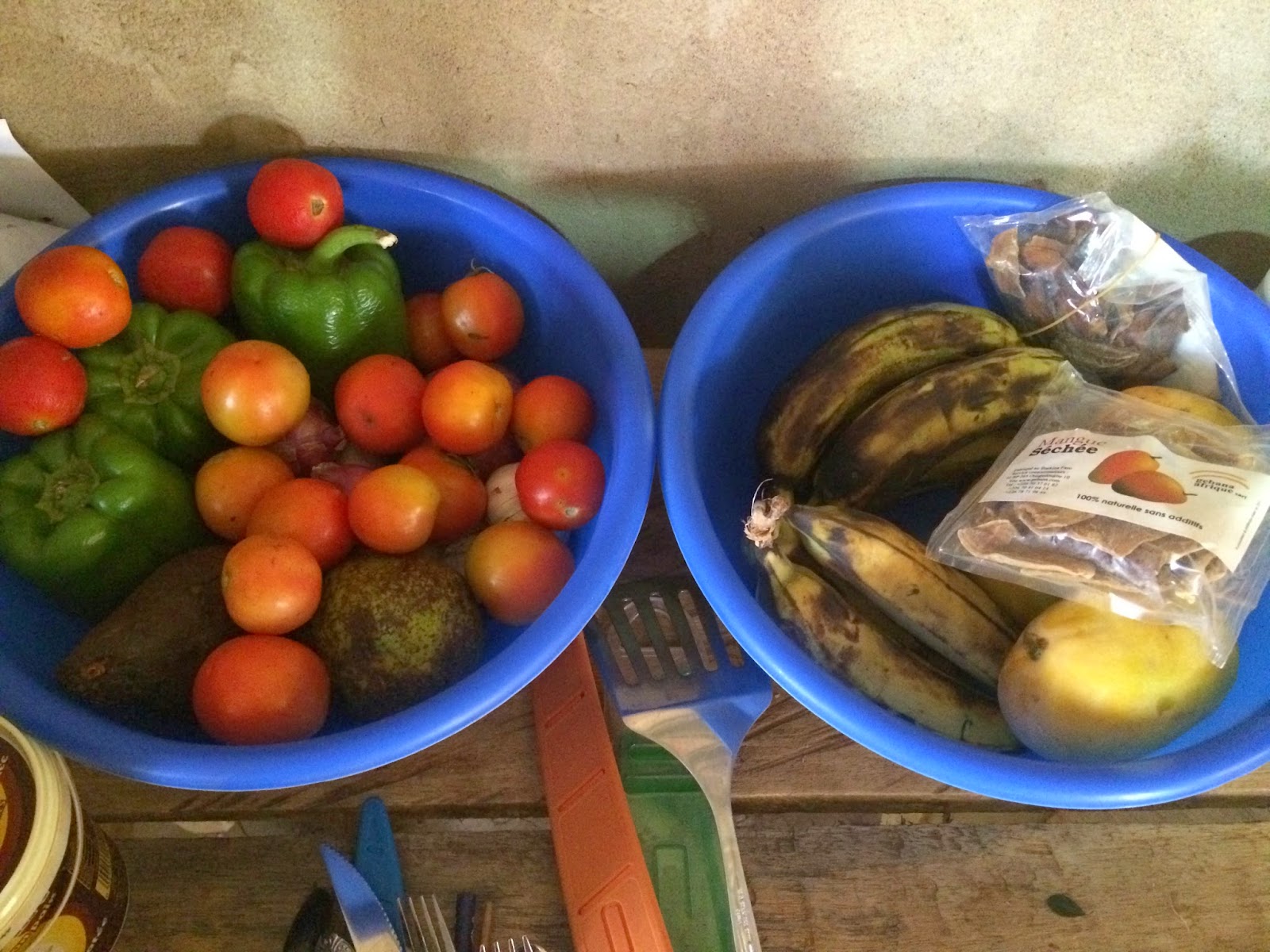
This is one of my favorite photos. Whenever I return from a bigger city with a large-selection of vegetables and fruits I always stock up and eat like a king for the next couple of days. Growing all types of vegetables is possible in my village, but there wouldn't be a market to sell them since people don't buy them for their nutritional value.

Everything else is great over here. Of course life is way different and difficult at times, but I see that my neighbors are living in the same conditions as me so I just have to accept my fate and move on. It’s almost been 4 months here in Burkina. It’s gone by SO fast. Right now we are in the thick of the hot season so it’s typically above 100 degrees all day long. The rainy season is approaching and I honestly cannot wait for that first rain. It’s going to be awesome.

Until next time,

MB


 Camel Spiders. Aren't they cute? I tried to catch this one for a pet but ended up killing it instead. Oops


Saturday, April 4, 2015

The Big Move

My true Peace Corps experience has finally begun. I’ve started my stay in Ramsa which will last for 2 years. So far, all is good and the move has been easier that I previously imagined.


Leaving the South
My fellow PCVs and I said goodbye to our host families in the South of Burkina Faso on March 15th. We spent 8 weeks living with our host families while undergoing volunteer training. For me, there was initially a big cultural and language barrier that kept me from growing close to my host family (in particular my host mother who I interacted with the most). As the weeks passed and they saw me less as a foreigner we all grew closer together. I would keep the women company while they cooked and introduced a plethora of new activities to amuse the children. By the end of my stay, especially the last week, I had grown very close to my new family. Our small village had a goodbye-ceremony for the volunteers and immediately after I headed back to my courtyard to spend one last night with the Dagano family. I wanted a group photo with everyone if my courtyard, but if I had known what an ordeal it would be I wouldn’t have tried in the first place. It was impossible to have the children sit in one place, none of the neighbors knew how to use a camera and each time a picture was taken the kids would break formation to try and catch a glance of the photo. Nevertheless, I was able to a few photos of the family and me.


Most of my host family, The Daganos. Wasila and Abdullah, my host mother and father, are to my left.


This was after I gave my host brothers a soccer ball. They seemed pretty stoked, especially Wahido in the middle. 


My host sister Bakisu helped me a ton. She spoke French and helped me fix any problems I had. Labayato and Missiran down below. They warmed up to me after a few weeks. 


My host grandmother and the wives of my host father's brother. I didn't interact with them much at first but towards the end we grew closer. 


I felt it appropriate to give some parting gifts to the family as a token of my appreciation for welcoming me into their home for 2 months. One of my favorite aspects of Burkinabe culture is how appreciative everyone is for receiving the littlest things, whether it be a handful of peanuts or a new soccer ball. Saying this, each member of my courtyard was stoked on the gifts I gave them. A soccer ball for the boys (which after receiving, the oldest boy proceeded to have a mini-stroke of enjoyment my jumping up and down and rolling around in the dirt), cookies and candies for the girls, pagne (nice fabric that women wrap around and use as long skirts) for the women and a calendar and beef jerky for the father. Each one of them thanked me about 5 times over the course of that final night. Talk about appreciation.

Saying goodbye was difficult even though we all knew it was coming. Everyone told me that I must return and that I am always welcome to stay at their house if I’m in the area. The mother, Wasilla, started tearing up as I said goodbye to her. It’s not common for people to cry or express emotions in Burkina Faso, but nevertheless it happened. As I rode off to meet the Peace Corps bus for our voyage to Ouaga, I realized that I was going to miss Zoro (the name of my village). It was in Zoro that I got my first true taste of Burkinabe life and saw first-hand the differences between American and African culture. In Burkina, family comes first above all else. Everybody helps out and plays their role. The Burkinabe are a happy people who constantly maintain a positive attitude even when their socio-economic situation matches the true definition of “poverty”. It was also in Zoro that I witnessed the gross gender-inequalities and difficult living situations. It is hard for families and their children to improve their situations because education doesn’t come first, so most of the times children don’t make it past middle school and/or high school and continue in the same professions as their parents. The quintessential Burkinabe saying “Ca va aller” (which loosely translates to ‘such is life’ or ‘everything will eventually work out’) perfectly encompasses the mentality that I saw in Zoro. People do their best to overlook their problems and move forward, but at the same time they do not confront their problems and work until a solution is found.

A group of us treked it to the edge of Burkina Faso. Clara and Meghan (to the right of me) ran while the rest of us took our bikes. C'tait une bonne aventure!


Officially becoming Peace Corps Volunteers
We all spent roughly 5 days in the capital in-between leaving Léo and moving to our new permanent sites. The main event during this transition phase was our swearing-in ceremony at the US Embassy where we officially became Peace Corps Volunteers. The ceremony went well but we weren’t allowed to take our cameras into the embassy so we couldn’t get any photos of us in our sweet Burkinabe outfits. If I receive any photos from the PC bureau I’ll post them later on.


Cam, Henry and I after our swearing-in event at the embassy. We had custom Pagne shirts and pants made for us. 

The rest of the time was spent doing a little bit of administrative work and a whole lot of exploring the city. It was adventurous to wander around the city seeking out tiny hole-in-the-wall bars and getting lost. We all knew that this was our last hoorah together before going solo for a couple of months at site so we made the most of it.


The boys and I went shopping for a grand meal we made at the transit house. Our taxi pulled up and was blasting the "let me take a selfie" song (which is a ridiculous American techno song). Needless to say we jammed out the entire cab ride. I brought my gopro along and of course snapped a couple selfies. 


When the day came to finally take off it was a bit emotional, but not really. Back in the day before technology and cell phones in Africa I’m sure leaving for site would have been a bigger ordeal. However, all volunteers are on a phone plan where we can call each other for free. We also know that we will be seeing each other probably once a month to hang-out in the capital, so it wasn’t goodbye for the next 2 years.

It’s been a big change from seeing my friends every day to being the only American/Westerner in my village. However, the friendships formed over the first two months in Burkina will no-doubt keep me sane over the next two years. They’ll be there to help me during my low points and I’ll do the same for them.

First Two Weeks in Ramsa
I officially moved into my new house on March 20th. The move wasn’t a grand affair this time around, since I had already visited Ramsa four weeks prior. The Peace Corps car unloaded all of my baggage and belongings, did a quick inspection of my domicile and then took off. I’ve heard stories and read on some blogs that watching the Peace Corps car drive off could be horrifying and evoke feelings like “Don’t leave me!” or “I’m not ready for this.” Not for me. The transition was smooth and after a few days in Ramsa, I already felt like I’d been living there for a month.

My House and Courtyard: My house and courtyard are still not entirely complete but the finish is in sight. I still need to buy a bed and a fan for inside my house. I ordered two locally made tables which are on the way. As for my courtyard it’s still a dirt wasteland filled with rocks and trash. I hope in the near future I will be able to plant the trees I bought and cover the dirt with this material called “zeka”, which when mixed with a bit of cement forms a solid surface. Besides that my house has a cozy feel and I spend most of my time outside on the patio under my overhang anyways.


The front view of my house. Shower/latrine to the left. My big over-hang and patio area in front. There are houses in front and behind my house. To the sides are open fields. 


My main room / kitchen. My table holding my water filter, stove and food. I have to keep my bike indoors because the children and adults are obsessed with it and always screw up the gears when it is left outside. 


My bedroom. I've yet to buy a bed but I'll pick one up soon. For now I sleep in my bughut and on a sleeping pad. 

Food: The food situation here is alright so far. My village has a marché every three days, where I buy my bread, vegetables and grains. My local boutique sells canned sardines so I usually get those for protein. The vegetable situation is a bit limited compared to my friends down in the South, whose marchés are overflowing with a variety of vegetables. For me it’s just onions and tomatoes but I make it work.

In the morning I have (instant) coffee, oatmeal that I bought in the capital and some bread and butter spread. For lunch there is a little stand that sells ground-up cassava, fish and vegetables for 200CFA (~40 cents) so I eat that every day. It’s delicious. Dinner is sporadic. I’ve eaten tô with my village chief and with Hermane, my counterpart. Most nights I eat by myself and I sauté veggies with fish and put it over some grain. 

Work: The first three months of my Peace Corps service is called the “Etude de Milieu”, or community analysis. The Peace Corps prohibits us from starting any projects within our first three months of service so that we can really learn the culture and understand the needs of the community and my work organization. I have a local language tutor who is helping me learn Mooré. Learning the local language is paramount for me, since not many people speak French and I need to speak it to communicate with the non-educated members in my work groups. Simple activities like hanging out at the boutique, sitting in someone’s courtyard while they cook, or drinking dolo (locally made millet alcohol) with the village elders don’t seem like “work” activities, but they help facilitate my integration into the community so it technically is work. I’m going to also get involved with the middle school, more specifically their English classes to provide some free expert English knowledge.

To make things clear I’ll explain the organization I’m paired with and my role for the next two years. Catholic Relief Services (CRS), which is a large multi-national NGO, has a program in Burkina Faso called SILC, or small internal loan communities. Basically, this means that they trained my counterpart Hermane to form small microfinance groups in Ramsa of 20-30 people and help them save money. Most people in these groups and illiterate and innumerate, so Hermane’s literacy and numeracy is what enables the groups to keep track of their savings and loans. Each group meets once a week for 10 months and puts away around $1-5 each meeting to be stored in the groups chest. Each person must also take out a small loan ($20-30) every month and use it to invest in their work, whether it be their small business, farm, garden or animal husbandry enterprise. At the end of the 10 months, each person takes out their savings and uses it for a variety of stuff, whether it be for their children’s school fees or if they are saving up for a large purchase such as a solar panel or motorcycle. However, almost every single person in Ramsa is a farmer during the rainy season so most of the savings go towards the family farm.


An example of one of the women's savings groups that my counterpart runs. A few women handle the money while my counterpart calls out each women to give or receive money. 


As for me, I won’t be involved in any of their weekly savings activities. Instead I’ll be working with Hermane to boost his capacity as the overseer of these groups and help each SILC member (around 500 in total) improve their upon profession. Obviously I’m not a farmer or gardener so I won’t tell them how to farm better, so what will I be doing? I’ll be introducing better management practices and business techniques (such as record-keeping, value-chain analysis, market research and marketing techniques) to the members and also introducing new Income Generating Activities (IGAs), such as mango drying, shea butter transformation or soy transformation into tofu. The ultimate goal is to not only improve the incomes and overall socio-economic statuses of the SILC members, but to make all the new practices I introduce sustainable so that they’ll be carried-on long after I leave Burkina.


A few women's groups already know how to make liquid soap. My counterpart was trained on this activity and is slowly teaching it to each group. 


So, for the next few months I’ll be meeting all of the groups in Ramsa and having discussions with them to better understand their work. With Hermane we’ll be learning the needs to each profession, performing a SWOT analysis, learning their daily schedules and length of a typical production cycle, and also collecting some baseline data on their current practices. By the end of my etude de milieu, I should have a solid understanding of the makeup of my SILC members and from there, start thinking of trainings and projects to execute in the future.

Life in Ramsa: Overall, it’s hard for me to complain about anything here in Ramsa. Life is good and I’m glad that the Peace Corps and my stay in a developing country is actually happening right now. I know it will be even better once I start doing some work with my group members. Sometimes I do find myself looking around at the vast desert, the mud-brick houses, the children is ragged clothing and women fetching water and think to myself “how the hell did I end up here?” But, I always come back to the realization that this is what I’ve wanted to do for some time now and things will become “normalized” soon enough.


At one of the local cabarets (dolo huts) at 8AM in the morning. Dolo is consumed all throughout the day, especially during the dry season when everybody is waiting for the rains to come. Most women spend all day working the small businesses, running the house hold, fetching water and cooking while the men usually sit around in the shade, drink or take naps. A bit of gender imbalance here.

At times it feels as if I’m living in a fish bowl here in Ramsa. My biggest question is whether it is just like this because I just got here or if it’ll be like this for the next two years? Probably somewhere in-between. In the mornings when I jump-rope, everyone passing by my house just stops and stares at me (sometimes I just stop jumping and stare back at them, and after 5 seconds they carry on haha). My outdoor shower’s walls aren’t that tall so my shoulders and head stick out, so of course whenever I shower people stop and stare. When I exit my courtyard to go somewhere or get some food I always hear people passing by or at the water well say “….nasara….narsara…” which means white person or foreigner. It guess it’s a grand spectacle whenever I do anything, and for me it’s absolutely hilarious. I always laugh it off and just make the best of it. I realize that for one, it is so bizarre for them to have an American living in their small village and secondly they do everything with the nicest intentions towards me. So, all is good.

My Peace Corps group’s motto is “accept your fate” here in Burkina Faso. I say this to myself a couple times a day whenever I’m faced with an awkward or different situation. But, it always applies whenever I find myself sweating profusely. This is about 50-95% of the day. I sweat upon getting out of the shower, whenever I touch another body part or simply zipping up my mosquito tent. On especially hot days I can drink around 3 liters of water by midday and not even have to use the bathroom because I’m sweating so much. But, if a breeze comes buy and cools the sweat, now that’s a nice feeling.

Update: I’ve been composing this blog over the past week. Just yesterday I found out that I may end up teaching English at the middle school for the final two months of school. The governments been having some issues paying teachers after the political crisis last October. So, the English teacher took off and now the school doesn’t have an English teacher. Peace Corps desires that all its volunteers are flexible, and that is exactly what I’ll be while helping out my community. If they need a teacher, I’m their guy. Just wanted to add that, and I’ll let you all know how it ends up going in my next post.


Until next time,

MB

Wednesday, March 4, 2015

Site Visit: Visiting the village where I’ll be living for the next 2 years

Two weeks ago I went on quite an adventure, since it was filled with lots of traveling and brand new experiences. Everything happened so fast, but I’ll do my best to recount the events that took place as I was welcomed into my new home village (for a brief introductory visit). 

First, I headed to the national capital for 3 days where I met for the first time my work and community counterpart. His name is Hermane Ouédraogo and he is a nice, honest and respectful man. A bit on the shy side, but I feel that this is because I’m the first American he has ever met and naturally there is a small adjustment period. In my village, he’ll be in charge of helping me assimilate into the community, meet important people and most importantly help me carry-out my work projects. 

While in Ouaga I was also able to experience the city for the first time and eat some over-priced, non-Burkinabe food. For the past 4 weeks we’ve eaten nothing but traditional Burkinabe food. While delicious, we all still missed our comforting Western food. Each PCV splurged on our first couple of meals while in Ouaga. I spent 9,000 CFA ($18) the first day on meals consisting or chicken sandwiches, fries, schwarma, beer and most importantly ice cream! (To put that amount in perspective I’d usually only spend 200 CFA on lunch and maybe 1,000 CFA on beer and snacks). The most bizarre thing that happened was that I saw a picture of the Manhattan Beach Pier in of the Burkinabe restaurants. I couldn’t believe my eyes and of course I had to take a picture. 


The Manhattan Beach Pier in Burkina Faso

After the fun couple of days in the capital I set off to the village of Ramsa, which is about 260 Km away from the national capital. I took a large charter bus for 3 hours to my regional capital. I didn’t fit in the seats, but I feel like this is something that I’ll just have to get used to being 6’6. I then waited 4 hours before I was able to get on a bush taxi (or van jam-packed with passengers and luggage) and go to my village. It then took me an hour by dirt road to get to Ramsa. 


Bush Taxi packed tight!

The events that happened after arriving in Ramsa are a blur to me. So much happened in that 2 hour time period, but I’ll never forget any of it. I was first driven to the Village Chief’s house where I was greeted by 10-15 important community members (the Owner of the gold-mining operation owns the only car in the village). The Chief wasn’t there, so after 10 minutes I hopped back in the car and went to the next location. Turns out there were 150 community members waiting to greet me at a large welcoming ceremony. I was shocked to see so many people awaiting my arrival. Most of them had been waiting since that morning for me and I got there around 4 PM. I was given some fresh water and millet-flour water, which is tradition to give to any foreigner traveling to that village. Hermane introduced me to the crowd and said some words as to why I was there. He then called me up to introduce myself and talk a bit about my stay in Ramsa. I charmed the crowd with my local language, saying some very basic phrases. I then went on to talk some more in French about what I’ll be doing over the next two years, my excitement for seeing my new home and how grateful I was for them letting me stay in their village. My counterpart translated everything I said to the crowd (since only a small percentage of the population can speak French).

After the ceremony was finished, a group of women formed a large mass and began to dance and chant. This was how I was transported back to the Chief’s courtyard so that we could have an entire second ceremony just for the Chief. It was a surreal moment being surrounded by one hundred or so Burkinabe as they sang songs in their local language. I took it all in and it felt awesome. It was comparable to being a celebrity with everyone around singing praises towards you. After I chatted it up with the Chief (who is very well spoken in French), a dance circle formed and of course I joined in. Everyone went around in a circle and repeated the same steps. The crowd was watching me and loved that I was going for it. It must have been pure entertainment for them seeing a huge white man dancing among African women. 

The day ended as the crowd guided me to my new house. It was newly built by the community and free for me. It’s tiny by American standards (maybe 8 x 18 feet with one door and 4 windows) but it’s just as big as the other houses in my village. In Africa people only sleep indoors, while the rest of the day is spent outside and in the shade. I can’t complain about my house or the lack of “things” because it was given to me for free. The fact that these community members spent their own money to build me a house humbles me a great amount. It gives me a great deal of hope for the community’s willingness to work with me and accept me as one of their own. That night, as I was sitting alone in my house after dinner, I felt pretty numb due to the great deal of events that just happened. The realization that I was going to be living in Africa for the next two years finally set in. Some lonely days, weeks and months were ahead of me. But then I started to receive some texts from my fellow PCVs checking-in and everything felt alright again. This is why the Peace Corps is so great. The support network that is formed my living with 40 other Americans for the first 3 months of training is what keeps everyone afloat over the two year service. I also know that I’ll make plenty of life-long friends in my village who will keep me happy.


The committee that fund-raised and built my house, free of charge to me! My counterpart Hermane is wearing the light blue polo.

 The rest of the visit was filled with lots of small rendezvous with various community members. I met all of the religious leaders, the functionaries (or government employees – more specifically, the head nurse at the health clinic and the directors of all the schools) and plenty more villagers. Also, when I opened my house door each morning at 7AM I would get a steady flow of visitors wanting to introduce themselves and chit-chat. It is Burkinabe culture to execute long salutations and I got a large taste of this while at site. Almost each time I met someone new, they would ask me about my health, family, work, sleep, travel and then go on to bless me a few times. And, this isn’t a one-time thing. Over the next two years I’ll constantly be engaging in these extensive salutations. 

Finally, the best part in my mind about this site visit was getting to know my counterpart Hermane better. He was with me the entire time and there was a lot of good dialogue between the two of us. I got to learn about his culture and he asked me a bunch of questions about the USA. We discussed some of the potential projects that we think the community would see as helpful. I know there will be even more to discover about him once I can speak his native language.

I head to Ramsa to live there permanently in 3 weeks. I don’t think I’ll have internet access once I’m there, so I’ll have to go into neighboring villages to post on this blog and use the internet. Besides that, everything else about this Burkinabe life is going well for me. Everything that was once shocking has become normalized. 

Until next time,

MB

In other news:

  • I attended my first wedding this past weekend in a neighboring village where some of my PCV friends live. Weddings are a crucial cultural event where everybody joins-in on the festivities. It starts with an enormous motor-carriage around the neighboring villages and towns when 50-100 motorcycles go around honking their horns. When I got there, my friend Henry and I meandered around and saw tons of people sitting around eating and drinking (non-alcoholic beverages, since was in an Islamic community). A couple friends and I then joined this group of old women in their hut to eat some rice, sauce and intestines. It was a comedic situation for all of us as we squatted around a bowl eating intestines at an African wedding. After we found ourselves at the main gathering point where a live band was playing music with 100 or so women dancing around. My group of 4 guys and 4 girls decided to join in on the fun and immediately everyone started cheering at us. It was so much fun. We joined the conga line and afterwards grooved out to the music. I don’t think any of us will forget that wedding. 

The wedding dance floor. Soon after I took this picture, we jumped in the conga line and grooved out.


Cam, Ruby, Henry and I dancing in the middle of wedding dance floor. Everybody watched us the entire time. Such a great time.
  • In Burkina Faso everything shuts down from around 12-3 each day. The heat is too immense so everybody goes home to eat lunch and lounge around. This is the best news for me because it means that I get to nap every day! I plan on setting up a hammock or nice lounge chair in my hangar so that each day I can repose in comfort.